

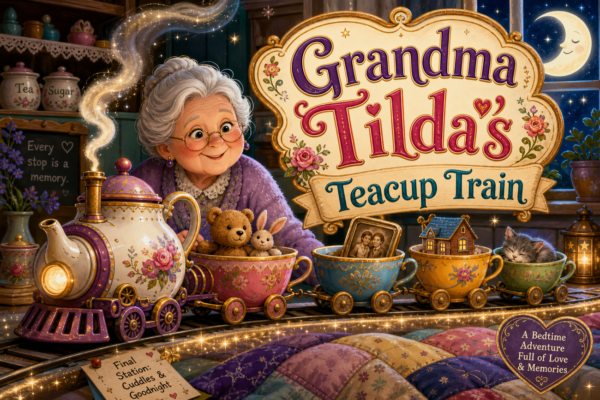
Grandma Tilda’s Teacup Train
Every evening, just when the sky turned the soft blue of a robin’s egg and the first star blinked awake, Grandma Tilda tied her lavender apron strings into a bow.
Her kitchen always smelled like cinnamon toast, warm milk, and the little mint leaves she kept in a pot on the windowsill.
On the highest shelf, above the flour jar and the honey bear, stood Grandma Tilda’s teacups.
There were six of them, each sitting on its own saucer, each with a painted flower curling around its side.
One had pink roses.
One had blue forget-me-nots.
One had yellow daisies.
One had tiny violets.
One had orange poppies.
And the smallest one, no bigger than a plum, had silver stars all around the rim.
Every night after supper, Grandma Tilda washed the dishes, wiped the crumbs from the table, and hummed a tune that sounded like rocking chairs and rain.
Then she would lift her granddaughter, Maisie, onto her lap.
“Is it time?” Maisie would whisper, though she already knew the answer.
Grandma Tilda would smile, and her eyes would twinkle like the sugar bowl.
“It is almost time,” she would say. “The moon must peek in first.”
So Maisie watched the kitchen window.
Outside, the garden tucked itself in, folding its leaves and nodding its flowers.
The moon rose slowly over the fence, round and creamy, like a biscuit made of light.
At last, one silver moonbeam slipped through the window and landed right on the shelf of teacups.
Click.
Maisie sat up straight.
Clickety-click.
The pink rose teacup gave a tiny wiggle.
Clink.
The blue forget-me-not cup slid forward on its saucer.
Clink-clink-clickety-click!
One by one, the teacups hopped down from the shelf, light as soap bubbles, landing neatly on the kitchen counter.
Their saucers rolled behind them like little wheels.
The smallest cup with silver stars gave a cheerful ring, and the other cups lined up in a row.
A sugar spoon leaped from the drawer and became a shiny front whistle.
The honey bear’s red cap popped off and settled on the rose cup like an engineer’s hat.
Grandma Tilda leaned close to Maisie and whispered, “All aboard the Teacup Train.”
Maisie giggled softly, because bedtime magic was best when it was quiet enough not to wake the breadbox.
The teacups clicked together, handle to handle, saucer to saucer.
Then the tiny train began to move.
Clickety-clink, clickety-clink, around the counter it went.
It puffed little clouds of steam that smelled like chamomile and vanilla.
The moon watched through the window, smiling its round moon smile.
At the first stop, the train rolled beside the flour jar.
The rose teacup gave a gentle ding.
Grandma Tilda touched the flour jar with one finger, and suddenly the kitchen seemed full of the smell of fresh pie.
“This is Flour Jar Station,” she said.
Maisie snuggled closer.
“When your mama was little,” Grandma Tilda said, “she stood on a stool right there and helped me make apple dumplings.”
“Did she make them pretty?” asked Maisie.
“She made them lumpy,” Grandma Tilda said, “and that made them perfect.”
The rose teacup whistled softly, as if it agreed.
Grandma Tilda continued, “She sprinkled flour on her nose, her elbows, and even the cat, though the cat did not order any.”
Maisie laughed into Grandma Tilda’s sleeve.
The Teacup Train clicked on.
It curved around the butter dish and rolled toward the old wooden clock on the wall.
The blue forget-me-not cup rang next, clear and sweet.
“This is Tick-Tock Station,” said Grandma Tilda.
The clock’s hands pointed to bedtime, but its face looked friendly and round.
“When I was a girl,” Grandma Tilda said, “my father wound a clock just like this every Sunday evening.”
“Did it tick loud?” Maisie asked.
“Oh yes,” said Grandma Tilda. “It ticked like little boots walking through a quiet house.”
Maisie listened.
The kitchen clock ticked softly.
Tick, tock.
Tick, tock.
“It helped me fall asleep,” Grandma Tilda said. “I imagined each tick was carrying my worries away in a basket.”
Maisie thought that was a very useful kind of clock.
The train moved again, past the napkin basket and around a sleepy spoon.
At the third stop, it paused beside the potted mint on the windowsill.
The yellow daisy cup bobbed happily.
“This is Mint Leaf Station,” Grandma Tilda said.
The moonbeam shone through the little green leaves.
“When your grandpa courted me,” Grandma Tilda said, “he brought me mint from his mother’s garden.”
“What does courted mean?” Maisie asked.
“It means he liked me very much and tried not to trip over his own shoes while saying so,” Grandma Tilda explained.
Maisie smiled.
“Did he trip?” she asked.
“Once,” said Grandma Tilda, “but only into a patch of daisies.”
The yellow daisy cup gave a tiny jingle.
Grandma Tilda plucked one mint leaf and rubbed it gently between her fingers.
The room filled with a cool, sweet smell.
“Grandpa said mint was a brave little plant,” she said. “Even after winter, it always found a way to come back.”
Maisie breathed in the minty air and felt warm under her nightgown.
The Teacup Train rolled along the windowsill, very carefully, past the moon’s bright patch of light.
The violets cup chimed next when the train reached a framed picture near the sink.
In the picture, Grandma Tilda stood beside Grandpa under an apple tree, both of them much younger and laughing.
“This is Apple Tree Station,” said Grandma Tilda.
Maisie looked at the photograph.
Grandma Tilda’s hair was brown in the picture, but her smile was exactly the same.
“That apple tree stood in our first yard,” Grandma Tilda said. “Every autumn, it dropped more apples than we could ever eat.”
“What did you do with them?” Maisie asked.
“We made pies, sauce, cider, and one year, an apple crown,” said Grandma Tilda.
“An apple crown?” Maisie’s eyes grew wide.
“Oh yes,” said Grandma Tilda. “Your mama wore it for exactly three minutes before she declared it too delicious and ate the jewels.”
Maisie laughed so hard she nearly slid off Grandma Tilda’s lap.
Grandma Tilda held her snug.
The violet cup rocked gently on its saucer, as if it too remembered the apple crown.
On went the train, clickety-clink, clickety-clink.
It turned around the breadbox and chugged toward the tea tin with the painted blue lid.
The orange poppy cup rang next.
“This is Rainy Day Station,” said Grandma Tilda.
The kitchen grew cozy and still, as if it remembered rain tapping on the roof.
“When your mama had the sniffles,” Grandma Tilda said, “I made tea with lemon and honey in this very kitchen.”
“Did the tea make her better?” asked Maisie.
“The tea helped,” said Grandma Tilda. “But the best medicine was a story, a blanket, and someone to stroke her hair.”
Maisie leaned her head against Grandma Tilda’s shoulder.
Grandma Tilda’s hand moved softly over Maisie’s curls.
“Like this?” Maisie murmured.
“Just like this,” said Grandma Tilda.
The poppy cup made a sleepy little clink.
Then the Teacup Train came to the smallest cup, the one with silver stars.
It shone brightest of all in the moonlight.
The tiny cup gave a bell-like ting.
“This,” Grandma Tilda whispered, “is Star Cup Station.”
The train stopped in the middle of the kitchen table, where a quilted mat lay waiting like a little station platform.
Maisie’s eyelids felt a bit heavy now, but she kept them open because this was her favorite part.
Grandma Tilda reached into the pocket of her apron and took out a small folded paper star.
It was pale blue, with Maisie’s name written on it in silver pencil.
“Every child needs a bedtime wish,” Grandma Tilda said.
“What kind of wish?” Maisie asked.
“A soft one,” said Grandma Tilda. “The kind that can float under a pillow and make dreams gentle.”
Maisie thought carefully.
Then she whispered, “I wish for the Teacup Train to know I love it.”
The star cup gave such a happy ting that the sugar spoon whistle wobbled.
Grandma Tilda tucked the paper star inside the little cup.
“That is a fine wish,” she said.
The moonbeam widened on the table, and for a moment, all six cups glowed as if they held tiny lanterns.
Then the train began its last journey of the night.
It circled the kitchen once, twice, and three times.
Clickety-clink, clickety-clink, softer and softer it went.
The rose cup yawned with a delicate clatter.
The forget-me-not cup leaned sleepily against the daisy cup.
The violet cup nestled near the poppy cup.
The star cup blinked its silver rim in the moonlight.
At last, the train rolled back up the counter, climbed the moonbeam like a shining little ramp, and settled itself on the high shelf.
Each teacup sat neatly on its saucer again.
The sugar spoon slipped back into the drawer.
The honey bear’s red cap returned with a tiny pop.
The kitchen became ordinary once more, but only in the way a warm blanket is ordinary.
Maisie yawned.
“That was a very good ride,” she whispered.
“The best kind,” said Grandma Tilda. “One that brings us home.”
She carried Maisie down the hall, past the quiet clock and the sleepy houseplants.
Maisie’s room was waiting with her quilts turned back and her stuffed rabbit resting on the pillow.
Grandma Tilda tucked Maisie in, first the flower quilt, then the blue quilt, then the soft patchwork quilt with tiny stars stitched along the edge.
Maisie wriggled down until only her nose and eyes peeked out.
“Grandma,” she whispered, “will the Teacup Train come again tomorrow?”
“If the moon peeks in,” Grandma Tilda said, “and if the cups are not too busy dreaming.”
“What do teacups dream about?” asked Maisie.
Grandma Tilda sat on the edge of the bed.
“Oh, warm hands, sweet tea, birthday cakes, rainy windows, and children who listen with their whole hearts.”
Maisie smiled.
“That sounds cozy.”
“It is,” said Grandma Tilda.
She kissed Maisie’s forehead, soft as a falling feather.
Then she began to hum the tune that sounded like rocking chairs and rain.
Maisie listened as the house grew gentle around her.
From far away in the kitchen, or perhaps only from inside a dream, she thought she heard one last tiny sound.
Clickety-clink.
Maisie smiled into her pillow.
The moon shone on her window, the quilts held her close, and Grandma Tilda’s hand rested warm and kind over hers.
At the final station of the night, there were no tickets to punch and no whistles to blow.
There was only a sleepy cuddle, a loving goodnight, and the softest dreams waiting to carry Maisie till morning.
Read more bedtime stories here: